





By Matthew W. Elious · Editorial
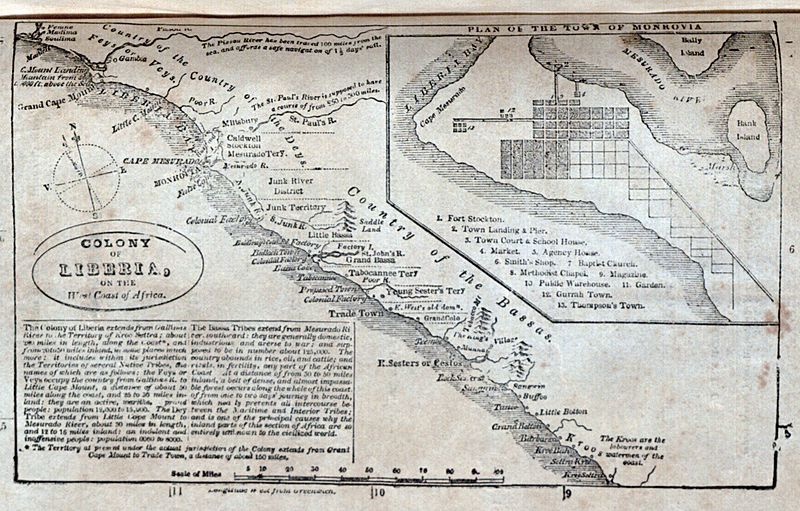
Liberia is the only country in sub-Saharan Africa that was not colonized by the resource-seeking, labor-seeking military powers of Europe. Liberia was founded, instead, by freed Black American slave-settlers who came to these shores to form a country. The country they came to form was a circumscribed territory comprising scattered pockets of tribal communities, each organized for subsistence living — small, dispersed, self-sufficient at the scale it had chosen to live. Into this landscape the settlers arrived carrying the legal vocabulary of the Republic they had left behind: a Constitution, a Bill of Rights, faithfully transcribed. What they carried, and how they came to carry it, is the beginning of the pattern of things this editorial is written to name.
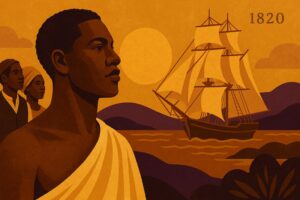 To understand what the Black settlers help build — and what remained beyond their reach — we must first be honest about the American culture they came from. The settlers came out of an America culture where the Americans themselves had invaded the territories of scattered pockets of small subsistence communities and forged them, by expansion, into a larger community of people called a country. That was the practice of the age. It was the practice of the Western powers generally, and the freed Black settlers of Liberia were not students of that practice — they were its victims. They had been removed from these very shores by it, carried across the ocean by it, and held in bondage within the country it produced. The expansion, acquisition, infrastructure- building practice that formed America was a practice they had witnessed from the inside of its machinery, not from the seat of its authorship.
This is the historical human condition that any honest account of Liberia must begin with. When the Black settlers arrived to found their Republic, the practice that had built an expanding, infrastructure-developed America did not arrive with them at full force. It arrived restrained and confined. It became what history calls the Americo-Liberian practice: a developed pattern of governance, faith, education, and settlement held largely within its own communities, along the coast, at the scale the settlers could author for themselves. This was not a failure of character. It was the natural shape of a practice constrained by bitter memory of their own experience — a pattern of things developed from the vantage of an enslaved people remembering the way things were done, rather than a free people who had done them.
The distinction matters, and I ask the reader to sit with it. A people who build a country as free authors internalize the pattern of building: the organization of labor, the discipline of construction, the machinery of expansion, the formation of citizens into a workforce that makes things. A people who watch that same building from the condition of slavery receive the pattern differently.
They see its products — the courts, the constitutions, the churches, the schools — more clearly than its formation, because the formation was the very thing done upon them and around them, never entrusted to them. So when freedom came and a new country was to be made, what transferred most faithfully were the words and the themes. The settlers transcribed the Constitution with precision. The deeper pattern — the deliberate formation of a whole citizenry into builders — was the part of the American practice they had been positioned to endure, not to author. No people should be faulted for reproducing what their traumatic experience had filtered.
Over time, the settlers gradually brought the indigenous communities into their thinking and into their practice. This, too, must be recorded honestly: the effort was real, and it was fraught with unrealistic expectations on both sides. The settlers expected the indigenous communities to adopt a pattern of life that the settlers themselves held only in restrained form. The indigenous communities expected inclusion into a Republic whose forms had been drawn from a distant country neither side had authored. Both expectations were human. Both were reasonable from within each side’s inherited condition. And both went unmet often enough to leave marks the country still carries. This editorial assigns no blame in that history. It records a meeting of two peoples, each shaped by forces older and larger than themselves.
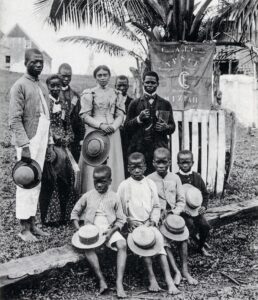 There is a second pattern of things worth naming, and it concerns the indigenous communities the settlers met when they arrived. They were not pressed by their environment to develop beyond subsistence living. There is a reason for this, and it is geographic, not moral.
In thirty-five years of practice as an aerial survey and geodetic engineering professional, I have observed the earth almost daily from a bird’s-eye view. When I look at Liberia from aerial or satellite imagery, I see a country that is, in objective natural terms, close to a Garden of Eden. Rivers and streams flow from coastal waters and the high plains of abundant rain. Thick rainforest holds rich vegetation. Animals and birds populate an environment of self-sustaining abundance — sufficient to support subsistence fishing, subsistence hunting, subsistence rice farming, with no environmental pressure forcing any community to develop beyond what the land would freely provide. Life in this near-Eden was so naturally convenient that the indigenous communities settled in small, dispersed family groups, sufficiently spaced to maintain their subsistent abundance. Over centuries, this pattern produced a small country of more than sixteen distinct dialects, many of them mutually unintelligible between intermittent neighboring communities.
This is not a criticism of the indigenous Liberians. It is a description of what happens when a population lives in a place that does not impose on it. Cold weather, scarcity, and seasonal pressure produced, in other lands, tools, ships, mills, factories, and institutions. Abundance and year-round provision produced something else: communities that lived well at the scale they had chosen to live.
So here is Liberia’s founding condition, stated whole. A settler people carrying the remembered patterns of a building country, restrained by their own history from internalizing all its formation patterns. An indigenous people whose environment had never demanded formation of them at all. And between them, a gradual, good-faith, and often disappointed effort to become one people. Neither carried the pattern. Neither could have. The full pattern of things that builds countries was absent from both inheritances — for reasons that reflect on the character of neither.
And so I come to the question. What is this pattern of things? How did the countries that built great infrastructure actually do it? Which wall did they climb that we have not?
The answer is simple and demanding. It is the same answer a doctor gives an overweight patient who asks how to lose weight. The doctor does not produce a sophisticated theory. The doctor says: exercise. Routinely. With discipline. There is no other consistent, results-oriented path. The patient may not like the answer. The answer does not change.
Countries that have built infrastructure and institutions have done so by organizing their citizens into a doctrine of physical work with their hands. There is an uncomfortable historical coincidence here that deserves to be named, not concealed. The human history of war led many countries to institute compulsory basic training for physical development, discipline, and stamina. Citizens who came out of those programs — even when the wars themselves were morally compromised — became the citizens with the discipline, drive, and endurance to build things. The countries then observed in peacetime what war preparation had shown them: that civilian compulsory or near- compulsory formation of able-bodied men and women produces a citizenry of disciplined energy, which can be applied to the building of the country itself, not only to the bearing of arms. This pattern was practiced in South Korea, in Japan, in China, across much of Europe, and in the United States in various forms. In Africa, it has been adopted in recent decades by Rwanda and Ethiopia. The countries that built moved through this gate. The countries that did not build did not.
This pattern was, briefly, practiced in Liberia. I record this in my book and I record it here. My father was formed by it. He recognized, having seen pictures of the great infrastructure of foreign lands, that those structures had not arrived from thin air. They had been built by people who worked diligently with their hands. He saw the same truth in the missionaries who came to Liberia — missionaries who built schools, sanitation, and water systems with their own hands, alongside the work of the Gospel they had come to preach.
The lesson of Liberia’s founding condition is therefore not a matter of capacity, and it is not a matter of blame. It is a matter of formation. Where history withholds the pattern and the environment does not impose it, an institution must supply it. That institution — the deliberate civilian formation of citizens through physical training, work with hands, and the building of things — is the wall that the building countries climbed and that we have not.
The Liberian doctrine I propose is not military conscription. It does not criminalize non- participation. It is a near-compulsory national service in which Liberian youth and able-bodied adults are organized for civilian formation — physical training, hands-on construction, county- level infrastructure work, and the building of permanent local capacity. Service becomes the expected path, with real incentives for completion and visible opportunity costs for those who decline. No citizen loses their rights for declining. Many doors simply become harder to open without the formation the Republic has decided to value. This is the wall.
I anticipate hesitation. There will be donor partners who will privately or publicly counsel against a near-compulsory program of civilian formation on the grounds that it sounds illiberal, that it conflicts with the vocabulary of contemporary human rights, that it carries unpleasant echoes of conscription. I respect the concern. I will also name it plainly. The same governments whose representatives may discourage this for Liberia are the governments whose own citizens were formed, in living memory, by exactly such programs — South Korean conscription, Swiss civil service, Israeli national service, the Civilian Conservation Corps and Works Progress Administration of the American 1930s, the post-war reconstruction labor formations of Western Europe. I would ask them gently: by what reasoning is what built your country considered inappropriate for ours?
 Liberians are not strangers to the diagnosis of our country’s difficulties. We can be, and often are, harsher in our self-assessment than any foreign observer would dare to be. But for two hundred years our self-assessment has too often taken the form of assigning fault between the two inheritances of our founding — settler and indigenous — when the honest record shows that neither inheritance contained the pattern, and neither people chose its own condition. The argument between us has been an argument between two peoples who were each denied the same thing. That recognition does not diminish anyone. It frees everyone. It moves the question from who failed to what was missing — and what was missing can be supplied.
To lose weight, you must exercise. There is no consistent alternative. To build sustainable infrastructure for the country we live in, we must organize the citizens of Liberia into the disciplined, hands-on formation that every building country has used. There is no consistent alternative to this either.
This is the right wall to pattern. We have climbed others for fifty years and arrived nowhere. The diagnosis is settled — and for the first time, it is a diagnosis that indicts no one and enlists everyone. The question is whether this generation is willing to climb the wall that holds, or whether it will leave that climb to a generation not yet born, the way the prior generations left it to others.
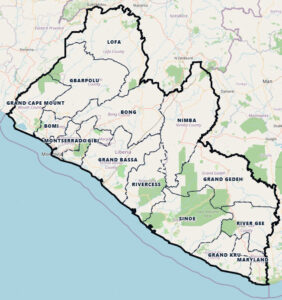
I have written a book (Rebuilding Liberia) that makes this case in full. The companion portal at LrOneMap.com measures the country we must build — because an argument of this weight cannot merely be declared; it must be demonstrated with visual evidence and empirical data. The case is documented. The evidence is public. The wall is named.
The climb is ours.