



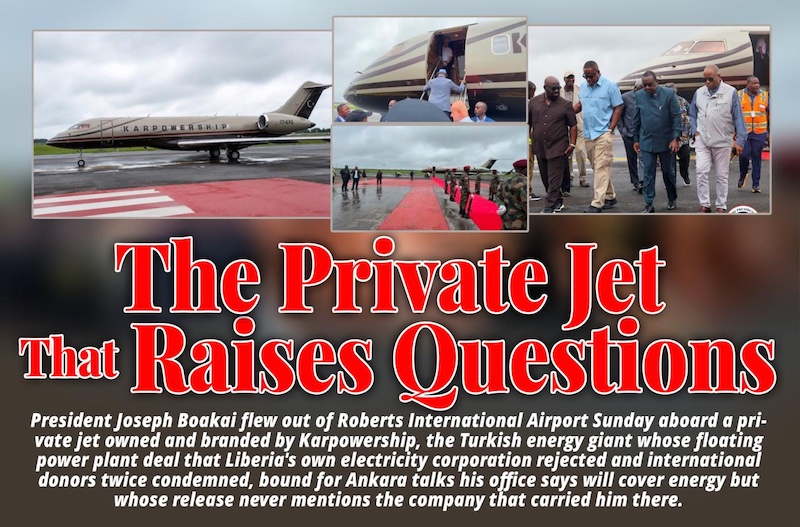
MONROVIA – President Joseph Nyumah Boakai departed Liberia Sunday aboard a private jet owned by Karpowership, the Turkish energy company whose floating power plant proposal was rejected by the management of the Liberia Electricity Corporation and condemned by international donors under two successive administrations.
The aircraft, bearing the bold inscription “Karpowership” and tail number T7-KPS, landed at Roberts International Airport at about 3:57 p.m. Saturday, July 5, from Ankara, Turkey, according to flight-tracking data. It departed RIA with the president on board Sunday morning, July 6.
T7 is San Marino’s aircraft registration prefix, a registry that allows foreign companies to hold title to aircraft through a locally domiciled representative; it could not be immediately confirmed by The Liberian Investigator through San Marino’s Civil Aviation Authority whether Karpowership itself is the certificate holder of record or whether the aircraft is held through a related entity.
Flightradar24 data lists T7-KPS as a Bombardier Global 6000, with its operator recorded as BE Aero. The publicly available flight history for the aircraft, which extends roughly a week back from any given date on the platform’s free tier, shows the jet routing through Seoul, Yangzhou and Changsha in China, then Istanbul, Reykjavik, Brownsville, Texas, and Los Angeles between June 19 and June 25 — a pattern that does not include a West Africa leg in that window and does not by itself establish the aircraft’s whereabouts in the days immediately before the July 5 Monrovia arrival reported here.
It is not clear under which conditions the President is traveling on Karpowership aircraft.
“President Boakai is expected to meet with his Turkish counterpart, President Recep Tayyip Erdoğan, to discuss matters of mutual interest and explore avenues for enhanced cooperation between Liberia and Türkiye,” the Executive Mansion release stated. It said the bilateral discussions “will focus on expanding collaboration in key sectors, including trade and investment, infrastructure, healthcare, education, agriculture, energy, and technical cooperation.”
The release added that the Liberian leader “will engage with prominent Turkish business leaders and investors to showcase Liberia’s investment potential and encourage increased private sector participation in the country’s development.”
The president is accompanied by a small delegation that includes Minister of State Without Portfolio Hadja Mamaka Bility, along with other senior government officials, according to the release. The president is expected to return at the end of the week.
Bility’s presence on the delegation is raising eyebrows among critics, who point to her role in the so-called “Yellow Machine” deal, in which construction equipment was routed to Liberia through her office rather than the Ministry of Public Works, and which the Public Procurement and Concessions Commission has said it has no record of approving.
Her appointment last month as Chairperson of the board of the newly constituted Liberia Corporation for Strategic Investment has compounded that scrutiny, with critics asking why a minister already under scrutiny over one procurement controversy has been placed atop a board created to oversee the government’s strategic investment agreements.

The Executive Mansion did not say who arranged or paid for the use of the Karpowership aircraft, whether the government chartered it at commercial rates, or whether the company’s long-pursued power purchase agreement is on the agenda in Ankara. The Executive Mansion did not respond to The Liberian Investigator’s inquiries.
The use of the company’s jet places the president in direct, undisclosed proximity to a vendor that has spent eight years seeking a contract from the Liberian state, a pursuit that has repeatedly collapsed under scrutiny.
Karpowership, the energy division of Turkey’s Karadeniz Holding, operates the world’s only fleet of floating power plants, with more than 40 vessels providing electricity across four continents, including several African countries. In 2023, the company shut off power to Freetown and Bissau, the capitals of Sierra Leone and Guinea-Bissau, over unpaid bills reportedly amounting to US$40 million and US$15 million, respectively, according to Semafor Africa. The company is currently engaged in advanced negotiations to extend its power purchase agreement with the Electricity Company of Ghana beyond its 2027 expiration and is in early-stage talks with Kenya about emergency power supply, according to Bloomberg, making the Liberia initiative part of a broader continental effort rather than a standalone move.
The company first sought a Liberian contract in 2018 under former President George Weah. That proposal, a 10-year power purchase agreement for 36 megawatts with a take-or-pay obligation binding the LEC to pay for all power produced whether consumed or not, drew a protest letter dated July 17, 2018, co-signed by the ambassadors of the United States, the European Union, Germany, Ireland, Norway, Sweden and the United Kingdom, along with the World Bank’s country director. The partners, who had invested more than US$825 million in Liberia’s electricity sector, warned that the deal would saddle the LEC with unnecessary debt and provide “more of what Liberia already has in excess,” according to the letter, which leaked to the Liberian media at the time. The Weah administration abandoned the deal under donor pressure.
In 2018, the Liberian media reported that the Weah-era push for Karpowership carried the influence of Ibrahim Mahama, brother of Ghana’s president, who reportedly provided President Weah a fleet of vehicles as gifts and the use of his aircraft. Eight years later, a President Boakai has again accepted the use of an aircraft connected to the same company, this time the company’s own branded jet.
Karpowership returned within weeks of the Boakai administration taking office. In a letter dated Feb. 15, 2024, the company’s Africa regional director, Emre Durmusoglu, wrote that Karpowership had introduced its powership solution to President Boakai on Feb. 5, 2024, held follow-up meetings with the LEC and the National Port Authority on the president’s instructions, and presented a term sheet for signature by the LEC and Karpowership Global DMCC. The letter stated that the company would “take immediate actions to realize the project as directed by His Excellency Joseph Nyumah Boakai.” It copied the Minister of State at the time, Sylvester Grisby, National Security Advisor Samuel Kofi Woods and then LEC Chief Executive Officer Monie Captan.

The LEC management under Captan reportedly rejected the deal. According to media reports, in 2024 that Senate Pro Tempore Nyonblee Karngar-Lawrence had a vested interest in a Karpowership contract for which she secured US$6 million in the 2024 national budget, an allocation LEC’s management turned back. Captan’s contract at the LEC was subsequently not renewed under circumstances that the media reported lacked full board approval. That account sits uneasily beside Karngar-Lawrence’s public role a year later as the senator who called for an investigation into a separate, disputed Karpowership budget entry; the Senate has not addressed the apparent inconsistency, and Karngar-Lawrence did not respond to a request for comment on the 2024 allocation.
The deal’s paper trail resurfaced in February 2025, when the fiscal outturn section of the 2025 approved national budget showed US$374,379 listed against the Karpowership deal for FY2024 despite the government’s stated rejection of the agreement. Finance and Development Planning Minister Augustine Kpehe Ngafuan told the Senate that “not a dime” was appropriated for Karpowership and attributed the entry to technical mislabeling, saying the funds went to the Liberia Refugee Repatriation and Resettlement Commission. Senators including Abraham Darius Dillon and J. Gbleh-bo Brown publicly disputed the explanation, and Pro Tempore Karngar-Lawrence announced a preliminary investigation. The outcome of that investigation has not been made public.
The Ankara trip also comes months after the Boakai administration signaled a shift in power generation policy. In March 2026, U.S.-based solar developer Sun Africa announced the signing of a memorandum of understanding with the Republic of Liberia for the proposed development of up to 500 megawatts peak of utility-scale solar generation paired with 200 megawatt hours of storage, unveiled at the Powering Africa Summit in Washington.
Any renewed Karpowership arrangement would revive the concerns that sank the 2018 deal: Liberia’s outstanding obligations to Ivory Coast under the CLSG regional power project, the take-or-pay structure of the company’s standard contracts, and the position of donors whose investments underwrote the Mount Coffee Hydropower Plant and the LEC’s grid expansion.
Source: The Liberian Investigator