





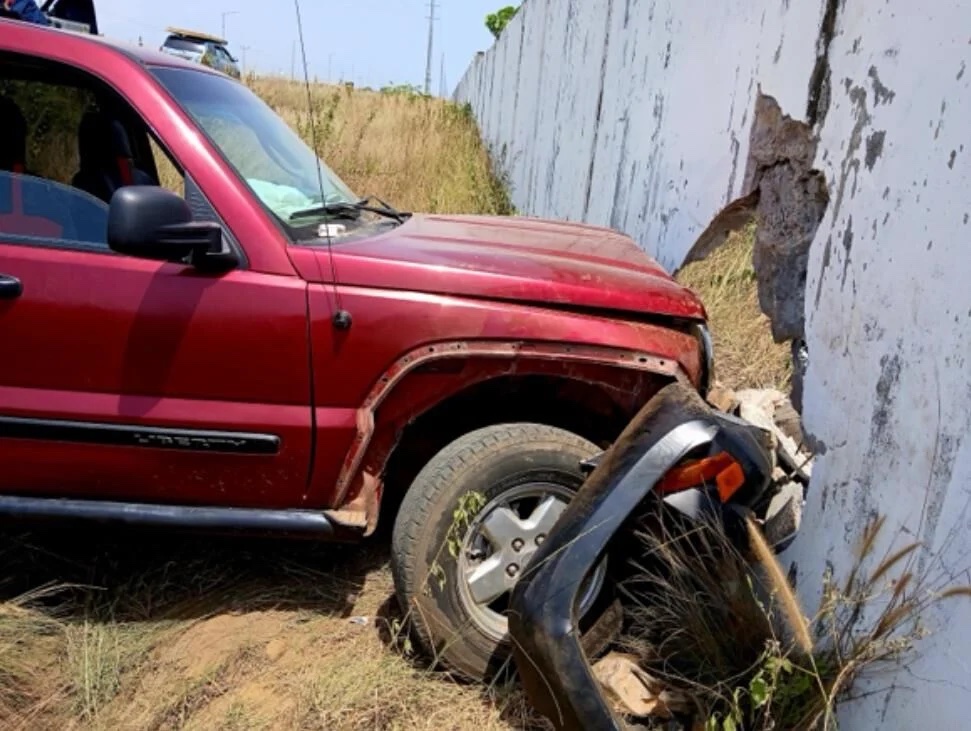
A terrible accident near the EBK Military Barracks on Thursday has brought attention back to the unsafe RIA Highway.
At approximately 12:20 pm on April 2, 2026, 42-year-old Romeo B. Kaioh was navigating the highway in a maroon Liberty Jeep, en route to a burial ceremony in Sinoe County.
The journey took a violent turn when Kaioh’s right-front tire burst. According to eyewitnesses, Kaioh was speeding moderately and swerved to avoid a motorcycle, causing him to lose control.
The vehicle’s steering locked, sending the Jeep careening off the road and crashing into the EBK Military Barracks fence. The accident left an adult female, identified as Ficial Sanbge, facing the consequences of the impact.
While the investigation continues, local residents say this is just the latest in a string of accidents caused by the deteriorating conditions of the unfinished road project.
For those living along the 45km stretch from ELWA Junction to the airport, the “four-lane superhighway” promised in 2020 has become a nightmare of dust and debris.
”This one road business is bad,” remarked a resident of the Boy’s Marshall area, coughing against the haze of red dust. “The government hasn’t told us anything. The dust makes me and my children sick constantly. It is simply not safe for our children to walk to school.”
The economic toll is equally devastating. Commercial drivers, who form the backbone of Liberian transit, report that their vehicles are being “eaten” by the road.
”Our cars are in the mechanic shop every week because of under-carriage problems. The rocks spoil our tires,” one driver said, his face etched with anguish. “We are heading into the rainy season, and it will be worse than ever. It feels like this government doesn’t care for its citizens. We are tired of talking.”
The RIA Highway project, contracted to East International, has been a saga of delays, audits, and ballooning costs. Originally estimated at $87 million, the price tag has surged to approximately $116 million—an eye-watering $2.5 million per kilometer.
Work was most recently suspended in January 2026 to allow the General Auditing Commission (GAC) to investigate financial discrepancies and the contractor’s performance.
While authorities claimed in February that the audit was concluded and work would resume, the heavy machinery remains silent.
The current project, Vital Signs, which commenced in February 2020, has reached an important milestone with approximately 32% of the work now complete.
Over the past few years, the team has been diligently advancing through the initial phases, focusing on research, development, and foundational infrastructure essential to the project’s success.
Despite challenges posed by external factors such as shifting market demands and unforeseen global events, the project has maintained steady progress, thanks to effective planning and collaboration among multidisciplinary teams.
As Vital Signs continues to evolve, the next stages will likely emphasize scaling up operations, integrating advanced technologies, and conducting rigorous testing to ensure quality and reliability.
With a solid one-third of the project complete, there is growing anticipation regarding its potential impact and the innovative solutions it promises to deliver upon completion.
Source: Liberian Observer