
The Government of Liberia appears to be on an increased revenue streak with the historic record of surpassing the $1B threshold. While this news is worth celebrating, there are many sectors with immense revenue potential that the government can tap into, and one of such is the aviation sector.
A reliever airport, as the name depicts, is an airport that relieves the larger airport (commercial service airport) of congestion and acts as the airport of choice to divert traffic to during irregular operations at the larger airport. Those irregular operations can be because of increased traffic, weather or mostly in the case of Liberia, when power goes off at RIA.
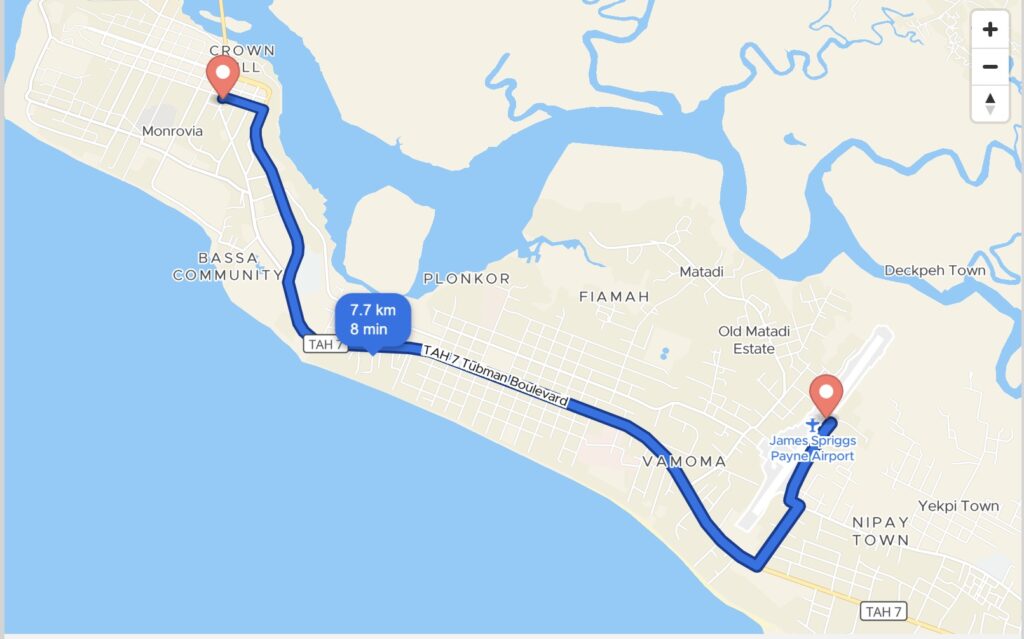
In short, Spriggs airfield should be upgraded and prepared to take flights bounded for RIA at all times, and this will help the government earn more revenue.
Why is this important?
RIA has often been in the news for mostly the wrong reasons. The news of power outages at the airport during flight operations often makes waves on the internet. Also, the news of flight cancellations for safety reasons does not give positive optics for Liberia and the airport image.
For instance, in May 2025, news circulated around the world that the President of Liberia had a close call when his aircraft crash landed at RIA and as a result, other inbound flights cancelled due to the accident aircraft being left on the runway.
When flights are cancelled due to the eventful occurrences stated above, Liberia loses revenue and attains a stained image. With such a stained image, attracting the right opportunities that Liberia is in dire need of, like foreign businesses and investment become a challenge.
Spriggs airfield has a long history of accommodating large aircraft from international destinations. For instance, in 1993, during the initial deployment of the Gordon Somers-led United Nations Observation Mission in Liberia (UNOMIL), a large Russian cargo aircraft landed at the airfield. The aircraft with the label “Heavy Lift” contained military personnel and logistics including a helicopter. It is noteworthy to mention too that in November 1987, the DC 10 aircraft conveying televangelist Jimmy Swaggart landed directly at Spriggs airfield from the United States. With a single asphalt runway of 6000 ft in length, the airfield also served as the only operational airport during Liberia long-running civil war. Regional airliners including Air Ivoire, ADC, Weasua Air Transport, Guinea Air Service, etc. made routine flights in and out of Monrovia.
I am providing the information above to highlight the operational capacity of the airfield as the basis for my advocacy for it to become a reliever airport so that Liberia does not continue to lose revenue to neighboring countries. Some years ago, when a RIA-bound KLM flight diverted to Freetown due to lighting problem at the airport, Liberia lost the landing fee and other revenues associated with that flight. Instead of diverting to Freetown, that flight could have landed at Spriggs airfield, if the airfield had the capacity to accommodate it.
Additional work needs to be done at Spriggs airfield to increase its capacity to prepare it as a reliever airport. My suggestion is to extend the runway (05/23) by another 4000 ft, rehabilitate and extend the only taxiway (if it is not yet done) and equip the airfield with instrument landing system (ILS). A 10000 ft runway is ideal to accommodate even the largest passenger aircraft like the A380s and B747s. While this may sound very ambitious, it is better to be prepared for the worst-case scenario and produce the best outcome.
Extending the runway will benefit Spriggs operational needs in many ways. For example, due to its size, the UNOMIL Russian cargo aircraft only landed at Spriggs airfield due mostly to the expertise of the pilots. Upon its final touchdown, there erupted loud clapping at the airfield, and the overall talking point was that “the pilots are really good!” The giant size aircraft made an initial approach from the mangrove swamp side (Larkpazee side) of the runway but ended up making a go-around. The aircraft then made another approach from the ocean side (Fish Market side) of the runway and finally touchdown. The large wingspan clipped banana trees on the “Wrotto Town” side of the airfield and the asphalt runway was in smokes due to the extreme friction because of the aircraft large size.
All the above would not have happened if the runway was at least 10000 ft. long.
When Spriggs airfield is rehabilitated as a reliever airport and it is published, the door of opportunities could open for other general aviation operations not imagined at this time. The airport could begin receiving non-stop international flights in addition to the existing operations at RIA. The airport could also begin receiving a stream of applications for general aviation operations and all this could mean more revenue for government and employment opportunities for Liberians.
I have no doubt that the operational team at RIA has the best intent; however, in the current age of instant information dissemination, public relations of an institution is defined by the perception mostly obtained from alternative news emanating from social media and that is why it is important that the government invests in the rehabilitation of Spriggs airfield to become a reliever airport to RIA.
The goal of this short article is to change the narrative so that the next time the news headline will be “Even though there was (blank) at RIA, all flights were diverted to Spriggs Airport”
Wishing all a rewarding 2026!
Jusu Gow, MSA, ACE
jgowus@yahoo.com